HEDDA (2025)

Written & Directed By: Nia DaCosta

Based on the play “HEDDA GABLER” by Henrik Ibsen

Cinematography: Sean Bobbitt

Editor: Jacob Schulsinger

Cast: Tessa Thompson, Nina Hoss, Imogen Poots, Tom Bateman, Nicholas Pinnock, Finbar Lynch, Mirren Mack, Saffron Hocking, 

In a provocative, modern re-imagining of Henrik Ibsen’s classic play, Heather finds herself torn between the lingering ache of a past love and the quiet suffocation of her present life. Over the course of one charged night, long-repressed desires and hidden tensions erupt-pulling her and everyone around her into a spiral of manipulation, passion, and betrayal.


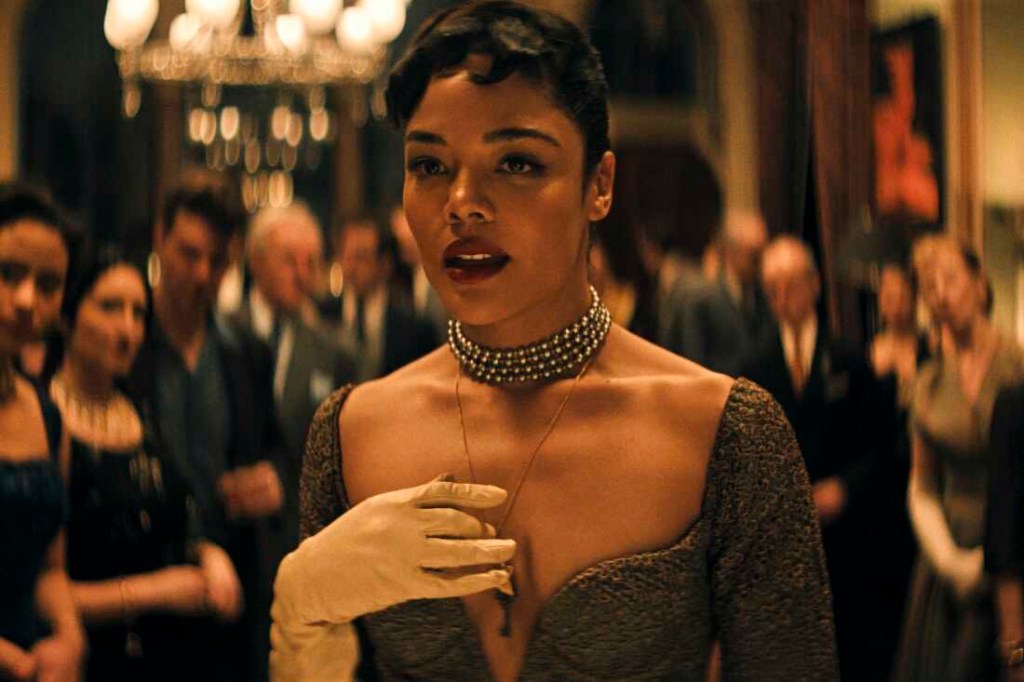
This is a film that understands atmosphere before it  worries about plot. It looks great deliberately gray, restrained, and textured. Which is impressive especially considering how much of it stays in a single location. The art direction, costumes, and camera work all do quiet but confident heavy lifting, turning limited space into something moody, elegant, and faintly suffocating in the best way.

Tessa Thompson is very good here, even if her affected accent initially throws you off. At first it feels like something you’re constantly aware of, but as the film settles into its rhythms, so does she. Once again, Thompson proves her range and commitment, leaning the character with a confidence that ultimately outweighs any early hesitation. She knows how to command stillness, and this film gives her plenty of room to do exactly that.

I’ll admit I went in blind, unfamiliar with the original play, and for much of the runtime I wasn’t entirely sure where things were heading. The narrative keeps its cards close, and clarity doesn’t fully arrive until the end. At which point it confirms what you may have suspected from early on. That slow reveal can be either intriguing or frustrating depending on your patience, but it feels intentional rather than careless.

One of the most interesting aspects is how the material is reframed around African American characters, along with more openly LGBTQ+ identities and the politics surrounding them. What’s notable is how relaxed the film feels about this. Instead of leaning into heightened tension or historical accuracy, it presents these dynamics as part of everyday life. Even if that ease may feel more modern than the period itself. That creative choice gives the film a looseness and accessibility that invites the audience to engage with the material from a fresh angle.

Though as shame as they’re are only three African-American characters, and by the end two will try to attack and kill each other. 

This isn’t an especially exciting film in the traditional sense. As period pieces rarely are, but the shifting power dynamics within relationships and the sharp, biting dialogue keep things moving. Conversations matter here. They keep the film alive and keep the audience leaning in, especially as everything circles around a lavish, almost dreamlike dinner party that feels both glamorous and quietly ominous.

Most importantly, this stands out as one of Nia DaCosta’s more original-feeling projects. While it’s still an adaptation, it’s not tied to sequels, franchises, or existing cinematic universes. You can feel her breathing a bit easier here, letting her style emerge more clearly and trusting the audience to follow. It’s a reminder of her talent as a filmmaker rather than a caretaker of someone else’s vision.

Hopefully, this leads to more projects where she has that kind of control. where she can fully flex her artistic muscles instead of feeling like a placeholder executing someone else’s plan. There’s a strong filmmaker here, and films like this suggest she’s at her best when she’s allowed to lead rather than follow.

As even after the film, one still is thinking about it

Grade: B-

TAR (2022)

Written & Directed By: Todd Field
Cinematography: Florian Hoffmeister 
Editor: Monika Willi 

Cast: Cate Blanchett, Noemie Merlant, Nina Hoss, Sophie Kauer, Mark Strong, Sydney Lemmon, Sylvia Flote, Zachary D. Smith-Gneist 

Having achieved an enviable career few could even dream of, renowned conductor/composer Lydia Tár, the first female principal music director of the Berlin Philharmonic, is at the top of her game. As a conductor, Lydia not only orchestrates, she manipulates. As a trailblazer, the passionate virtuoso leads the way in the male-dominated classical music industry. Moreover, Lydia prepares for the release of her memoir while juggling work and family. She is also willing to take up one of her most significant challenges: a live recording of Gustav Mahler’s Symphony No. 5. However, forces that even the imperious maestro can’t control slowly chip away at Lydia’s elaborate facade, revealing the genius’s dirty secrets and the insidious, corrosive nature of power. What if life knocks Lydia off her pedestal?


This film feels like an epic in its Scope and locations but also really for this one character. Who goes all over the spectrum of emotions and from being high on the horse to l falling so low. 

As impressive as the film is, the performance of Cate Blanchett is mesmerizing; it certainly helps that she is constantly on the screen and she is in every scene. This also allows us to notice that we see everything from her point of view.

We see how high her ego is but also how talented she is and can easily back it up. We see her views on certain subjects and life. As well as her behavior in life. 

We also see her downfall and never are quite sure if she is guilty or not, but we can see that those around her totally abandon her and now that the mighty have fallen are willing to sell her out. How some might have even conspired In her downfall, getting passed over once gotten what they wanted, has no problem only added to her downfall.

We never really get an answer to her guilt but can see questionable behavior. Such as threatening a little girl who bullies her daughter we might be able to understand that as a parent, but who is to say she doesn’t have that attitude with those older yet under her. Who needs her approval 

As she is touchy with younger students but that seems more free-flowing. We never see her victims, only glimpses of emails that her assistant has been keeping and filing.

It becomes a mystery in itself as to who exactly is behind taking her down. Though the film remains subtle. It keeps offering hints of what might be happening behind the scenes. Who might be holding grudges and why. As her attitude is flippant toward those around her.

In its own way, it is a tragedy that is a black comedy. In The second half, the film is systematically her downfall and her reaction to it as it happens and she gets more and more unbalanced. Which is when the true range of Blanchett’s Performance truly shines.

Then in the third act where she tries to get her career back and the lengths she has to go through just to work. All the way to a foreign land where even though she obviously dislikes her surroundings there are hints that she might be guilty of what she has been accused of as far as grooming. Such as when she goes to the massage parlor and runs out and throws up. We suspect that this is after realizing what kind of parlor it is, but also it might be after that she has to resort to paying for this kind of attention.

That is how the film presents her as a double-edged sword of someone who we could admire but also might be repulsive and guilty of her accusations. As even when she sees her brother he is nonchalant about her and his feelings towards her and why in pure and simple language.

That is the magic of the film. Everything is presented plainly but there are so many subtle hints that you never know exactly the truth only how she sees it. Even though the video footage was presented later we know was doctored. As we sat through her class and know her comments have been cut together. 

The film’s comedy is very dry and subtle but on second viewing it becomes a little more clear. As the first time, the film jsit feels devastating and the biggest joke of all is the finale. As we see the audience for her 

Grade: B+