PARTHENOPE (2024)

Written & Directed By: Paolo Sorrentino 

Cinematography: Daria D’Antonio 

Editor: Cristiano Travaglioli 

Cast: Celeste Dalla Porta, Silvio Orlando, Gary Oldman, Peppe Lanzetta, Dario Aita, Marlon Joubert, Luisa Ranieri, Isabella Ferrari

A woman born in the sea of Naples in 1950 searches for happiness over the long summers of her youth, falling in love with her home city and its many memorable characters.

————————————————————————

Director Paolo Sorrentino knows how to make things beautiful. He knows how to bring out natural beauty and what others might overlook this film, which looks more like a commercial at times with its images and characters, reminding one a film such as Terence Malik in this world there’s a visuals could be distracting , but also seem to be part of the storytelling as this film seems to more be about atmosphere and culture than anything else.

While this film is an epic in itself. It’s not as flashy as his previous films. As it is broad but feels a bit more modest and gritty. 

The lead character Parthenope played elegantly by Celeste Dalla Porta. which also has the name of the title was born in the sea. She seems to represent Naples, Italy itself, naturally, beautiful, and island separated from the rest of the world who either stare or wish to be near she must pay a price for her beauty as it causes Corruptions breakdowns, false promises, flirtations all around her as it tries to be itself, but at times can’t be selfish or all consuming not knowing its own power and strength and influence over others

The film provides many metaphors, but like it subject, it feels shallow and a bit too in love with itself as there is substance that doesn’t feel like it digs deep enough? As the audience takes us along its many paths. Though seems to get lost in itself. 

The subjects of the film, the director has explored before and deeper so much more so that this film that tries to be artistic comes across a little bit more mainstream, even with all of its indulgences

Gary Oldman is a selling point in his small role is writer, John Cheever, who you hope would help shape the story or being an interesting chapter as she would become amuse of his, but he seems more to help the film’s box office and as the only American character going with a recognizable screen presents Though seems more there as a memento or a devotion, a testament to the times

The lead actress is certainly beautiful and has a passing resemblance to actress Mia Sara she does what is expected of her as she continuously looks glamorous in bikinis and evening dresses, but through her journeys and some growth, you wish the film brought into focus more of the side characters like her acting teacher who shows up to give lessons, but truly proves to be nothing but smoke and mirrors

It feels like the film  MALENA by Giuseppe Tonratore as the film continuously focuses on her beauty, even when trying to show her as a full character whereas in that film, it humanized the title character, but we more got to see her from others point of view here the title character gets all these opportunities and meet so many influential characters because of her beauty and youth and constantly trying to figure everything out around her which also leads too many tragedies as she know so many

So that this film becomes a historic look at a beautiful woman overtime as well as the changing of the times of Italy that serves as a fictional biography of sorts. A romantic look back that surprisingly has little sex and isn’t as exploited as the directors previous films could be, but there does feel Like for all the access in this film. There’s also an emptiness to it.

Still a film to see, but not needed to be so lengthy when there isn’t that much to say 

Grade: B- 

CONTEMPT (1963)

Directed By: Jean-Luc Godard

Written by & based on the novel “IL DISPREZZO” By: Alberto Moravia

Cinematography: Raoul Coutard

Editor: Agnes Guillemot 

Cast: Jack Planace, Brigitte Bardot, Fritz Lang, Michel Piccoli, Giorgia Moll

A French writer’s marriage deteriorates while working on Fritz Lang’s version of “The Odyssey”, as his wife accuses him of using her to court favor with the film’s brash American producer.

————————————————————————

Tortured Myself again, by watching another Jean Luc-Godard From my Criterion Collection, sight unseen.

I know how dour that already sounds. You just have to know that me and Jon Luc Godard films have had a love-hate relationship. I have actually liked and enjoyed some films that I didn’t expect while other films that are considered classics I found rather boring noteworthy for different reasons.

I like the ideas of Jean-Luc Godard, in his style though the films not necessarily as much at times they work, but usually not at least for me as they become statements which might have worked at the time as bold but now come across as pretentious, cinematic, theatrical games, there is a living quality to them in an absurd quality, as they are usually quite beautiful, but leaves the audience lost to find their own way, which is commendable, if not having

I will say watching the movie is like reading a classic book you don’t like and wonder why so many do as it feels more like an assignment that you’re determined to finish 

This is one of those movies where you’re going to come up with your own theory or understanding of it so I’m only gonna present my interpretation.

Now it’s always entertaining watching a younger Jack Palance in a film, as well as young women, riding bicycles in skirts. Though watching Fritz Lang steal the movie in his scenes was worth it

It is another movie of Brigitte Bardot being torn supposedly between Teague lovers neither of which is seem a good choice, but one is better than the other and her never having chemistry who is the one who is older, has more money and seems more want her only physically.

This film is a satire film making, but it seems to turn more into a domestic drama romance of a deteriorating marriage.Even as it explores the themes of selling out or staying, true to your principles.

That was it’s a beautiful locations still end up being a hang out movie that is in the middle of paradise yet everyone is oblivious to the beauty of their surroundings or they’ve been there so long that it is normal to them, though the film still manage to showcase the beauty and appeal of Brigitte Bardot and it seems like while everybody in the film can see her beauty she is like the background to them. They’ve grown so used to her that it’s normal, but will still contest her. Well, the film and filmmaker bathe her and loving light as well as give her a meaty challenging role. Though questionable if you might actually like her by the end

One can say that at least she gets to play full character other than just a fantasy or an object of beauty pretty much a bombshell, though she does Grace the poster, so it she did help sell tickets for this phone as next to Jack Palance she’s the biggest name in the film and of course Fritz Lang. No, she seems to be the entrance or introduction for us to the Phil as the camera lingers on her

Throughout the film, we see the games that all the characters seem to be playing weather in love relationships filmmaking financing.

Now one can see where Martin Scorsese got part of his score of CASNO from. It gets  annoying a bit at times watching its source play throughout. The score “ST. MATTHEW PASSION BMV 244/PART TWO: WIR SETZEN UNS MIT TRANEN NEIDER”’By Johann Sebastian Bach 

Which leads me to wonder Did he use it to subconsciously say that all these characters are in this Idyllic Wonderland in that they are alienated from it due to mounting domestic pressures & alienation from one another

Didn’t expect this to become one of Godard Morchella Ching films even though it’s seams like most of them are as the film deals with alien nation. It almost feels more like a Michelangelo Antonioni film only no not as long, and this seem to have more of a cruel, ending the natural ending.

In the end, I have no problem, admitting maybe I didn’t quite get it as much as others did as I loved the concepts and drama that was introduced that lead to discussions and conversations even after you watch the film no again I can’t say I enjoyed it, or necessarily would need to watch it again

IL POSTO (1961)

Directed By: Ermando Olmi 

Written By: Ermando Olmi And Ettore Lombardo 

Cinematography: Lambert Caimi 

Editor: Carla Colombo 

Cast: Lordana Detto, Sandro Panseri 

Bursting with big dreams and plans, an Italian teen goes to Milan to work in a big impersonal corporate office, where he becomes disillusioned and drained of all his individualism.

————————————————————————

This classic masterpiece of Italian film is full of great moments. As it seems focused on two characters in particular, thst the film takes its time in introducing individually and to one another, but by the end becomes more of an ensemble.

The film tries more to be a docu-drama to make it feel more realistic which is why there are barely any credits. 

The film definitely paints a picture of a culture, time period and of business. How the film introduces us to individuals but by the end they become part of the system and almost nameless. Even though they all ah e their own conflicts and personalities. Though become defined by their jobs only. Another cog in the bureaucratic machine 

The black and white photography throughout gives the film and the tale a timeless nature. As it is a story we have seen many times but different locations and circumstances. As it tries to tell a tale of what seems like first love as an adult, but will it ever get that far or only stay a flirtation. Like when you see someone interesting randomly I. Travel or at an event. Where you seem to hit it off but will you ever see each other again or get a chance to let one another know how you truly feel about them after a few chance encounters. 

It offers the beginning of a romance that never quite starts. That gets lost amongst the many other responsibilities that are forced upon you. As you enter adulthood. 

The promise of something better thst never quite seems to come. While In The heartless system that seems to have bring them together, but also keeps them apart 

As In The beginning interviews it seems to be the go ahead and the beginning. As they are separated yet full of promise. Which leads to uncertainty. As there are no real duties and have nothing but time filled with hope. As he gets busier he manages to see her again. There is promise when she begs him to be at a New Year’s Eve party that she will be attending.

When we get to the party where him and a bunch of different characters t about heartbreak, but learn how to open themselves up to one another and manage to save the evening. Which leads to an ending of uncertainty and unresolved emotions. Where we hope for the best, but prepare for the worst.

Grade: A- 

THE LAUGHING WOMAN (1969)

Written & Directed By: Piero Schivazappa

Cinematography: Carlo Achilli and Sante Achilli 

Editor: Carlo Reali

Cast: Philippe Leroy, Dagmar Lassander, Lorenza Gueirieri, Valo Soleri, Maria Cumani Quasimodo, Mirella Pamphili 

Doctor Sayer, esteemed director of a philanthropic institution, hides a misogynistic and sexophobic personality to which he gives vent to weekends, dedicating himself in his isolated villa to sadistic games in the company of professionals expert in satisfying similar inclinations and staging their death in ways more imaginative. Taking advantage of the visit of one of his employees, Mary, decides to move from fiction to reality, imprisoning the woman and subjecting her to physical and psychological torture.

————————————————————————

Done with great style and craftsmanship, this film is more of a battle of the sexes type movie. As it plays like pop art and is filmed like a Giallo. 

Where a young woman falls under the spell of a masochist male and while catering to his every fetishistic whims.

He eventually does fall in love with her. Where we wonder by the end whonrealyl has the power and who was truly in control.

The film Does have some racy sex scenes that are titillating and also torturous. Making thaincoen across as FIFTY SHADES OF GREY way earlier. 

As this is like watching a porno with a plot only without any hardcore sex scenes. So that the thrills in this film is how far will it or the actors go. 

The soundtrack matches it scene by scene 

Though there truly seems to be very little going on and not much story. As the film seems to want tonturn you and and find thrills. As it tries to portray a cynical love story of sorts. That comes across as a thriller at times That sadly truly doesn’t have that much to say or offer.

It’s an erotic drama, or you could even say erotic thriller, though at heart this truly could’ve been more of an adult film with hard-core scenes as that seems to be its appeal because even the storyline is a little thin to make excuses for the places it goes, and there is supposedly an emotional component that it doesn’t feel that deep, But one could see how maybe the writer or director is trying to show a difference or how sex and emotions are linked for certain people.

Don’t exactly know what the film is trying to say. Doesn’t want us to watch all the pain this woman goes through and then pull the rug from Under us so that we watch as she survives but conquers and never was the victim At all? Though i’m sure certainly racy at the time. Now you just marvel at the production design and marvel at what they got away with.

As the film feels like a film not brave enough to be a full porno. So instead it tries to add a thin plot and stylish shots. That pornos of the time had, but maybe they wanted to put this out as a thriller. As it contains plenty of erotic scenes but while short you also hope that it is going to be a bout a little more. So don’t come into this film expecting too much more than titilation. So much so it feels more like a fetish film more than a feature film. 

Though with only the main two actors in the erotic scenes if it was a porno. It would ag e to have the audience focused on the main actors and being attracted to them. As there are barely any others to distract or pair off with. So it’s more a couples movie, hence romantic. 

This is the kind of film you would stay up late to watch as a kid on cable.

Grade: C+

BLOW JOB (1980)

Written, Directed & Edited By: Alberto Cavallone

Cinematography: Maurizio Centini

Cast: Danilo Micheli, Andrea Massarelli, Anna Bruna Cazzato, Mirella Venturini, Valerio Isidori, Antonio Mea, Alea Armani

Stefano Vicinelli and his girlfriend Diana fall two weeks behind on their hotel rent and face having their luggage and car impounded until they can pay the bill. Conveniently for them, a distraught woman in the room right above theirs leaps to her death from the window. Using that as a distraction, the lovebirds sneak out and take off. Running low on money, they pool what little cash they do have and go to the racetrack. Stefano encounters a crazed woman wearing sunglasses who demands he give her a key so she can unlock a door. After she calms down, she proposes a deal with him: She’ll help him win money in the horse race if he’ll help her “get past the gate.” Having no clue what she’s even talking about, Stefano reluctantly agrees and bets on her suggestion. After the horse wins and he collects, he feels obliged to accompany the strange woman – who introduces herself as Countess Angela – back to her home.


The film has a misleading title that seems used to get an audience interested. Sure, it’s an erotic movie that doesn’t actually show or revolve around the sexual act in particular. It hints at the act once. 

Though it is more like a softcore erotic movie with a supernatural plot that isn’t too convoluted but leads to erotic interludes. So that it literally feels like a porno with a plot and professional production values. That never goes in the direction of being a full hardcore adult film, but also barely has any direction. 

As it never quite comes across as a believable supernatural thriller either. Though the eroticism is the only thing that makes the film entertaining 

Strangely enough, the film takes itself too seriously instead of going full steam into a more cultural exploitation experience. 

There is of course plenty of nudity as well as softcore sex of all kinds, with a love story thrown in. The film feels heavily edited to make sure the action doesn’t go too far into more hardcore territory. 

The film’s plot really makes no sense. Though the movie tries to hypnotize the audience with surreal imagery. That feels more like arthouse pretensions with hippie philosophy and astrology thrown in for plenty of ceremonies. 

No, the grade isn’t because it doesn’t live up to the title, but at least if the filmmakers had just decided to go with a more out-and-out pornographic movie. Maybe the audience wouldn’t;t have been so let down by a title that seems more meant to shock, but ultimately becomes more a gimmick

Grade: F

THE POSSESSED (1965)

Directed By: Luigi Bazzoni and Franco Rossellini

Written By: Luigi Bazzoni, Franco Rossellini, Giulio Questi and Ernesto Gastoldi 

Based on the novel by: Giovanni Comisso

Cinematography: Leonida Barboni 

Editor: Nino Baragoli

Cast: Peter Baldwin, Salvo Randone, Valentina Cortese, Pia Lindstrom, Pier Giovanni Anchisi, Ennio Balbo, Verna Lisi, Philippe Leroy 

Famous writer Bernard travels to a small lakeside town for an off-season winter vacation. He checks into an old hotel owned by Enrico and his daughter Irma expecting to meet Tilde, the maid he had a crush on the last time he visited the town. However, he discovers that Tilde has committed suicide, and when he meets the local photographer, Bernard learns that she was pregnant. He becomes obsessed with finding out whether she really committed suicide and to guess what really happened. When Enrico’s son Mario and his wife Adriana arrive at the hotel, Bernard has daydreams about Tilde’s fate.


It’s true they don’t make films like these anymore and it’s a shame

This is a film. I have only heard about it recently. It’s a film. I am happy to have discovered it’s based on a true story. It might remind some viewers of Alfred Hitchcock’s Vertigo more for its obsession and mystery aspects than necessarily the filmmaking or direction.

Only here it’s an Italian film and it’s beautiful to look at and the woman at the center of the mystery is pretty though not as haunting as other heroines in this type of film.

Which has the main character, a photographer, and writer comes to town to look up a female whom he had an acquaintance and took pictures of the year before and might be hoping to romance only to find that she is dead and that it was murder. He finds himself obsessed with getting to the bottom of it, aided by the few friends in town who give him hints but never quite the full story. 

It’s a short film you can pretty much guess who the guilty is, though throughout there are plenty of twists and turns and revelations that you don’t quite see coming that even the audience is introduced to that the author has until certain aspects of the story come into play.

This isn’t a very romantic film, but it’s a film shot in black-and-white and looks beautiful and the film does stay haunting even after the ending is revealed and the third act is full of twist. The film isn’t as deep and penetrating as you hope it is quite a surprise for those who don’t know about this film that is worth seeking out.

This isn’t a super sleuth tail, nor is it a tale of unrepentant evil characters. As it unfolds It’s a story that feels all the more human and it fails with characters who are more three dimensional, and ultimately tragedy is a fulfilling film by the end. 

it can only go so many places, especially based on a true story. I can’t say it’s something you’ve never seen before but it is a story that will keep your interest. It not only focuses on the who but also the Y and the aftermath

Grade: B-

THE FORBIDDEN PHOTOS OF A LADY ABOVE SUSPICION (1970)

Directed & Edited By: Luciano Ercoli
Written By: Ernesto Gastaldi and Mahnahen Velasco
Cinematography: Alejandro Ulloa 

Cast: Dagmar Lassander, Pier Paolo Capponi, Susan Scott, Simon Andreu, Osvaldo Genazzani, Salvador Bugbeo

The wife of a struggling businessman is blackmailed by a mysterious man into having a sadistic affair with him, or he will leak evidence implicating her husband of murder.


This might not be a good film but stay for the look, style, and fashions. Which are especially memorable. Like a Vogue magazine pictorial only with a theme.

The film is so erotically lurid that it feels like a Joe Eztherhaus-type film script. As it involves blackmail and sex. Though more talked about and hinted at than shown. So not quite exploitive.

Most of the film plays into the main characters’ suspicions and sacrifices. It then finds itself focused on infidelity and her paranoia over it 

Which would place it more in the drama category. Yet plays like a thriller. Thought could easily be a foreign soft-core erotic movie. As the film seems to be more about the beauty of the female characters. 

It’s not really the mystery behind everything. It’s the whole experience. What I took away was taking it all in. Rather than trying to figure out a murder or mystery. It felt more like watching a drama 

As for a film that is filled with eroticism it isn’t as exploitive as one might expect. It does present a quite open sexuality, manner, and behavior.

Watching it feels like walking through a museum in a foreign land. It seems like everything is exquisite yet you are soaking through the past that is so close to the modern day. That you can still see some of these fashions in play maybe in more high society.

The character of Dominique wears a dress that practically has no sides to it. So you get to see her Frame and shape. Which makes her outfit an all-time classic. As she is the most interesting character in the whole film. You might find yourself wishing she had a spin-off. 

The film ends up more as a psychological drama than a giallo, which is what one might have expected. The film’s characters just offer a lot of threats.

Only in the last 20 minutes after 70 minutes of set up does the film truly become a thriller. Even after an opening scene that makes it seem Like one. 

What is impressive is that it feels epic yet really only has six cast members but plenty of locations 

The film lays it on a lot towards the end to offer a twist that should have been somewhat obvious. As it has a Colombo type of ending.

Close but no cigar 

Grade: B-

IL DEMONIO (1967)

Directed & Story By: Brunello Rondi

Written By: Brunello Rondi, Ugo Guerra & Luciano Martino

Cinematography: Carlo Bellero

Editor: Mario Serandrei

Cast: Daliah Lavi, Frank Wolff, Anna Maria Aveta, Dario Dolci, Francs Mazzoni, Rossana Rovere 

A lonely, sexually-uninhibited young peasant is subjected to an exorcism after she hexes a man who rejects her advances.


This is a film I had never heard of before and stumbled upon. Definitely did not regret it.

What will attract many to this film is the lead played by Daliah Levi, She is amazing in her role and quite gorgeous. That you can see why so many are tempted by her. She throws herself into the role even more physically in one acne where she continuously contorts her body. She is as beautiful as the cinematography throughout.

This is an obsessive love story that turns into madness and questionable passion or a growing mental illness that seems to grow into group hysteria. By the end of the film, there is barely anyone who is truly innocent.

This film can be seen as a precursor or maybe even an early inspiration for Isabelle Adjani’s Iconic performance in POSSESSION

The film is a neorealist Italian movie with religious overtones and folk horror elements.

The film plays out a tragedy really as for all of those supposedly scared of her. She is ultimately a victim throughout. Most of the men trying to save or cure her violate or viciously attack her. All of them so-called holy and come down with her throw her away. Even the man she is in love with the man who blames his lust for her. All on her as some kind of spell. 

At first, her lover does come across as a victim but becomes a villain by the end. As the film tries to showcase what has led him to this path. His own mind of mental breakdown is tied to religion, lust, and folklore. 

This film definitely shows how misogynistic and exploitive those so-called true believers are when it comes to women and especially if they show any sexuality or seem to enjoy sex 

GRADE: B-

POLIZIOTTO SENZA PAURA – MAGNUM COP (aka FEARLESS) (1978)

Directed By: Stelvio Massi
Story By: Fulvio Gicca-Palli 
Written By: Stelvio Massi, Franz Antel & Gino Capone 
Cinematography: Riccardo Pallottini 
Editor: Mauro Bonanni 

Cast: Joan Collins, Maurizio Merli, Franco Ressel, Werner Pochath, Massimo Vanni, Annarita Grapputo, Alexander Trojan, Gastone Moschin

An Italian private investigator tries to get to the bottom of a suspicious kidnapping case with the help of an exotic dancer.


This is a movie that leaves one with mixed emotions. At first, it feels like pure 1980s European sleaze and stupidity dialed up. To make what seems like a movie the filmmakers believe Americans will love. Though eventually the film actually becomes somewhat engaging.

Can’t really tell if it is natural or because the audience gets into the film’s nature and anything subdued is welcome and if it isn’t outrageous seems more possible than what we have seen before.

The beginning credits show us what to expect throughout, but feel more like credits for a television show of what to expect in future episodes. After a silly violent opening, it ends up being an early highlight reel to try and convince you to stay.  

This is truly a film that has to be seen to be believed. One of the aspects of the film that helped sell the film is that Joan Collins is in it and gets star billing. Even though she doesn’t appear until halfway into the film with a grand entrance and shows plenty of skin throughout. Even though she is a supporting character of importance she comes across as a special guest star who is eye candy and the femme fatale. She is the most recognizable cast ever to an English language-speaking audience. 

The film is definitely of its Time when it comes to Materials and culture. It has a protagonist who always seems to have a one-liner or comeback ready for every occasion. In one scene after getting beat up seems to look around for direction as to whether to at least lose consciousness in the scene. 

So that at first it feels more comedic than a thriller or action film. Even with an opening scene of pure action. The film also is filled with nudity and comes across at times as sex-obsessed. Not sure if it was intentional or not. Even though it is a detective mystery at heart.

The film eventually develops into competence as it goes along and we analyze the story. When it decides to calm down from its More outrageous factors. That ends up saving the movie. As it becomes engaging and less over the top.  

It seems that most of the female characters can’t resist the lead who comes across with a perineal that Bruce Willis would perfect in the 1980s 

Though it gets tawdry, especially in the conclusion that involves underage girls leaves this and the audience with a bad taste in your mouth and wondering why this was needed. As it makes the film obscene. This might be why this film isn’t as known or famous. As it is quite distasteful

Can definitely see this as a cult or midnight movie and gaining an audience. By the end, it feels like the first in a series of movies or franchises that are never to be.

Grade: B-

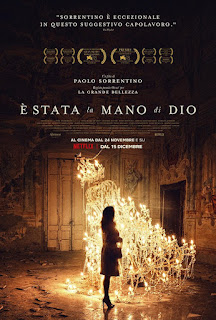
THE HAND OF GOD (2021)

Written & Directed By: Pablo Sorrentino 
Cinematography: Daria D’Antonio 
Editor: Cristiano Travaglioli 

Cast: Filippo Scotti, Toni Servillo, Teresa Saponagelo, Luisa Ranieli, Marlon Joubert, Renato Carpentier, Massimiliano Gallo, Betty Pedrazzi 

Fabietto Schisa is a boy in the tumultuous Naples of the 1980s. The Hand of God is a story full of unexpected joys, such as the arrival of football legend Diego Maradona, and an equally unexpected tragedy. Fate plays its part, joy and tragedy intertwine, and Fabietto’s future is set in motion.


This film is oddly restrained considering it is directed by Paolo Sorrentino. Whose films always lean on beautiful visuals, characters, and landscapes and usually showcase a surreal reality as well as feeling more epic in scope.

This film is autobiographical so that it feels more personal and with more depth. Not so much an ensemble but we do see the world of Neapolitan Italy through the eyes of our teenage protagonist. Though we spend a lot of time with his family and the characters he comes across. Who each affects and shape his life in some way

Some are more obvious and immediate, others we get glimpses of and then learn about them later but never quite forget them. As each has some kind of advice for the main character.

All of this is happening while in the background soccer player Maradona is bright onto Italy’s Team and is helping them win the World Cup. So Much so that the main characters’ activities are scheduled around seeing the games. 

As he interacts with his family we see plenty of domestic drama. Though throughout there is a love story but it is more between the protagonist and his aunt. Who has a mental illness or is treated like she has and wears provocative clothing and has no problem being naked whenever. Not exactly your typical movie romance. 

Though she is shown more as as a muse for him of free-thinking, humor, sex, and beauty and Luisa Ranieri playing aunt Patrica fills out the role beautifully. As the camera manages to make her look gorgeous no matter what the angle or lighting. Throughout the movie, there are female characters of great beauty who are treated as normal or every day.

The movie also managed to be one of the few films about filmmaking or future filmmakers that basically barely has any movies or talk of them in it. There is no film appreciation, though there is talk of Fellini, a filmmaker who Sorrentino can remind one of in telling personal stories in a grand way that always feels colorful.

This film doesn’t really follow a traditional plot or story and is more a collection of anecdotes and events that shape the character and give a vivid history and view of his hometown in the 1980s. Not as quirky as one might expect as there is nothing that truly stands out. 

Though by the end you are glad you watched and experienced the film that plays and feels more like a book by the end. Only here not everything is spelled out. It is more experienced, witnessed, and felt.

This is also a film best viewed in a theater or on the biggest screen you can find. 

Grade: B-