MOTHER MARY (2026)

Written, Edited & Directed By: David Lowery 

Cinematography: Andrew Droz Palermo and Rina Yang

Cast: Anne Hathaway, Michaela Coel, Fka Twigs, Hunter Shaffer, Sian Clifford, Jessica Brown Findlay, Kaia Gerber, Alba Baptists 

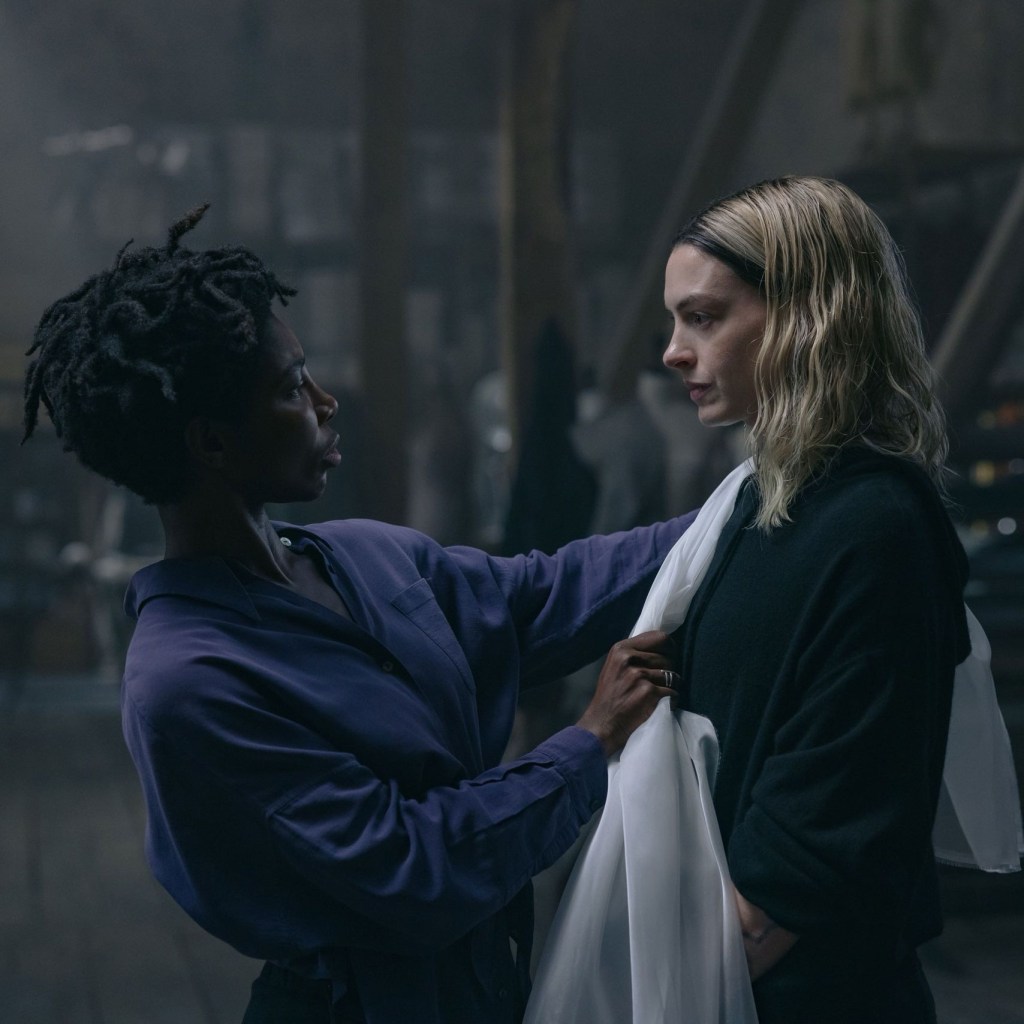
Long-buried wounds rise to the surface when iconic pop star Mother Mary reunites with her estranged best friend and former costume designer, Sam Anselm, on the eve of her comeback performance.


This is a movie that one didn’t dislike and found fascination at times within it, though at some parts of the film, found myself struggling to meet the film, even halfway

There’s clearly a lot happening here, and I admire what writer-director David Lowery is trying to do. The acting is strong, the visuals are inventive, and even the situations themselves feel inspired. There’s a real dramatic idea underneath all of it. The problem is that, somewhere along the way, you start wondering why are you still sitting here waiting for it to fully arrive.

The first half really catches you attention. There’s an energy and mystery to it that makes one curious about where it was going. But by the middle, that curiosity began turning into patience. The second half starts to feel a little empty and monotonous, and while the film continues to look beautiful, the visuals sometimes feel like they’re doing more of the heavy lifting than the story.

And yet, I can’t say I didn’t appreciate it.

This is essentially constructed like a play: a limited location, a handful of actors, and a story that depends heavily on the relationships between them. But Lowery finds clever ways to make the world feel larger than the space we’re actually in. There’s imagination here, and I have to applaud that. This is clearly one of those more personal, artistic projects where a filmmaker is allowed to follow his instincts rather than simply give us what we expect.

The film also leaves plenty of room for interpretation. You can read it as a story about collaboration, ambition, loss, regret, or the complicated ways people remain connected even after they’ve spent years apart. There’s a particularly interesting feeling of loss running underneath everything. The sense that these characters have both lost something important and are still trying to figure out whether they can somehow get a piece of it back.

And then there’s Michaela Coel, who is fantastic.

She has a presence that immediately pulls you in, and she gives the film an emotional center that it desperately needs. I honestly just want to see Michaela Coel in more things. She’s one of those performers who can make you interested simply by watching her think. She walks away with the movie. As I am a fan of her other work, obviously 

I really wanted to love this film. I admire its ambition, its originality, and the fact that it actually has something to say. I just wish there were more movie in between all those ideas.

Maybe that’s partly on me. This is the kind of film that asks you to meet it on its own terms, sit with its rhythms, and decide for yourself what it means. And perhaps I simply wasn’t in the mood for that particular challenge.

I can absolutely see myself revisiting the film years from now and appreciating it differently. It’s divisive, certainly, but it’s also the kind of film that gives people something to argue about afterward and honestly, I’ll take that over a movie I completely forget five minutes after leaving the theater.

So while I respect what Mother Mary is attempting, and I genuinely admire the vision behind it, I can’t quite give it the glowing review I wanted to.

It’s ambitious. It’s beautiful. It’s original. I just wish it had given me a little more to hold onto.

Grade: C

QUEER (2024)

Directed by: Luca Guadagnino

Written By: Justin Kuritzkes

Based On The Novel By: William S. Burroughs 

Cinematography: Sayombhu Mukdeeprom 

Editor: Marco Costa 

Cast: Daniel Craig, Drew Starkey, Lesley Manville, Jason Schwartzman, Ariel Schulman, Andra Ursata, Omar Apollo, David Lowery

In 1950s Mexico City, an American immigrant in his late forties leads a solitary life amidst a small American community. However, the arrival of a young student stirs the man into finally establishing a meaningful connection with someone.


This is director Luca Guadagnino’s second film released this year and while not making its mark as strong as his previous film of the year CHALLENGERS. It does offer another look into relationships and the destructive characters within them. It’s also another random adaptation for the director. Making a film from a legendary cult writer and book.

It was like going on a trip that ends up more as a journey and never quite knowing where it will Lead. Then being a guest in this limited epic. While witnessing a love story you want to see work, but ultimately see the cracks and the doom, but still holding out hope.

This film seems to be like the author of the book William S. Burroughs’s writings that could be episodic linear more stream of consciousness at times and little short stories that didn’t really have plots and were more like chronicles, but with all the names changed.

As the film works in different stages, either way, we get to know the lead character played by Daniel Craig, and the fact that he just seems lonely in various ways he tries to rectify that through the company of others, both physically emotionally, and socially. With excessive alcohol and always a pistol by his side, truly his only constant companion. He is also a functioning junkie in the first part of the film. We see his romance with a young man and all his longing for this young man and how it plays out it’s truly beautiful how he tries to court him when we see vague images of what he wishes, he could do to him alone like touching his face in a movie theater or stroking his hair.

The next part of the film seems to focus more on the drug addiction of the character. Now he has fallen in love with this young man, and the young man seems somewhat interested in him, but is emotionally absent to him that’s deepening his drug addiction. 

The next part is when they decide to take a trip together on the search for an elusive flower, and that journey into the jungles and Amazon, and how once it does, it provides quite a unique experience that deepens both of them, but also the rest of the film is more Jumps around and it truly starts to get into the more surrealistic images and hallucinogenic images where it goes more for the visuals and at this point either you’re with the film or you’re not.

This is an easy film to try and break down and explain you can bring up certain plot points, and things that happen and still never quite get to the point of the film or what you’re watching those films as an audience member you have to experience it and come out with your own meaning like it or not. As with its author and his writing, it’s not easily explained.

The film just seems to go along on its own journey, never rushed and never quite on the path you expect but at heart it is a love story that no matter what is timeless and easily identifiable.

The soundtrack includes a lot of the music of NIRVANA and PRINCE. One wonders if it is partially because of the past collaborations between the author of the book and the film is based upon William S. Burroughs and NIRVANA lead singer Kurt Cobain, but also a way to show they art can be timeless. Especially if it evokes a certain mood and atmosphere that is personal, identifiable, and universal in a sense.

Just like the title most of us know what Queer means to most, but here while it has its brushes with what most believe. It also goes out of its way to not be easily definable. It can be a title but never quite an entire identity. As so many have their own definitions of it. So just like the characters this film refuses to be one thing or ride along one wavelength. 

Grade: B