TOTALLY FUCKED UP (1993)

 Written, Directed, Edited & Cinematography by: Greg Araki

Cast: James Duval, Roko Belil, Susan Behshid, Jenee Gill, Gilbert Luna, Lance May, Alan Boyce, Craig Gilmore, Johanna West

Life really sucks for a group of gay and lesbian teenagers living in Los Angeles. Their parents kicked them out, they’re broke and bored, their lovers cheat on them, they’re harassed by gay-bashers. If things are going to be this way, maybe suicide isn’t a bad idea; at least not in the mind of Andy, our major protagonist, who gives the film its title by describing himself as “totally fucked up.


This film plays out more experimental than his last film. This film more examines days in the life of a group of friends. We get to see their videotaped confessions and each seeks to show their own little stories that overlap. So they end up all having their adventures. 

That watching the film feels ahead of its time as it comes off a little like the reality show, THE REAL WORLD but also what social media would become eventually. 

As from the first frame of a new clipping about teenage suicide in the gay community. We know what the film will be tackling not that it will eventually be prophetic 

If the audience does as we watch we try to figure out who will either try or allow themselves to do that. 

The film at the time was one of the most penetrating looks at LGBTQ youth that includes sex reckless and romantic and facing consequences for being themselves such as parents throwing them out, infidelity, random violence, looking for love in all the wrong places and people. 

It sets a blueprint for later teenage dramas that were diverse and more hard-hitting in the new Millenium 

This film was actually not as bleak as his previous film. At least not until the ending where we get a dark ending but also feelings. Which the film Seems to lack. As like the teen’s characters. They play up a certain persona but each is vulnerable that they hide from each other. 

The film stays upbeat and energetic throughout and then comes a heaven ending. Whereas THE LIVING END seems so hell-bent on nihilism until the end where it offers actually hope.

This film still has an avant-garde presentation and punk rock attitude and Sensibility. As well as the soundtrack, but surpassingly by the end it also feels like a hardcore after-school special.

The more artistic expression throughout the film. Can be hard to take, even as it breaks up and focuses on characters. Some in the audience might want more story or action throughout. If that is what you seek you came to the wrong movie.

Watching this now through a modern lens. This film is ahead of its time but could have only been made when it was. As it is penetrating and a nice time capsule of the times. Style and politics and just day-to-day life.

This would also be the first of many collaborations between director Greg Araki and actor/star James Duval 

Grade: B-
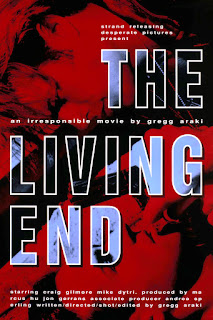
THE LIVING END (1992)

 Written, Directed, Edited & Cinematography by: Greg Araki

Cast: Craig Gilmore, Mike Dytri, Darcy Marta, Johanna Went, Mary Woronov, Paul Bartel 

Luke is a gay hustler. Jon is a movie critic. Both are HIV positive. They go on a hedonistic, dangerous journey, their motto “Fuck the world”.


Even though this is writer/director Greg Araki’s first film. This is one of the latest of his films I have actually watched. I have seen all of his work from the film THE DOOM GENERATION (His first self-proclaimed openly heterosexual film. His third actual film and the second in his teenage apocalypse trilogy) on.

I didn’t like that film. The film did fascinate me with its style, anger, and punk sensibility. This is why no matter what I always give Araki’s film a try.

This is his debut film. Where he pretty much made the film on his own. but also this was the start of the New Queer Cinema movement. 

Here the film doesn’t pull any punches. It is punk all the way. Angry, in your face, violent, no rules, and funny. The film has it’s messages and stylish selections throughout.

This wasn’t a film where its main characters were gay and sexless. Nor supporting characters in some straight love story. Or comic relief. They were the protagonists and very sexual which we see and good looking. Though also both are dying.

The film offers commentary on the world through side characters and their matter-of-fact dialogue. That works on a commentary of the social scene at the time.

It also offers a violent story with two lovers on the run. That actually seems like it is headed for tragedy and violence. It shockingly becomes something that is personal, emotional, and actually about the characters makeing a connection In all the chaos that is supposedly normal life. 

The characters and film both have a nihilistic outlook but end with finding connections and hope on the edge. Leaving a message of living life to the fullest While young. As the characters are the ultimate attractive outsiders who manage to find one another amongst the chaos.

The film wears its influences in it’s background with various new wave and Avant-garde film posters pampering the walls. Not to mention a cameo from cult actress Mary Woronov.

The film has a certain energy and excitement that it never keeps up with at first and that you think will keep up, but it slowly starts to pump its breaks and go slower and takes its turns with the characters. Losing its urgency but allowing for more depth. Still driven by music or the soundtrack. That comes off as inner monologues at times. 

Though there are straight supporting characters the film stays mainly with the main couple.

The film is less violent and more talkative than one would expect. 

As the film goes along they are lovers on the run whose relationship starts off more sexy and exciting. Though as the film goes along they get to know each other and form a bond and relationship. Driven by sex and end up finding love in their own nihilistic lives.

Random strangers in the background carrying messages that end up being the film’s sly commentary. As well as comic relief.

I can’t say I love this film, but it kept my interests mostly throughout and was refreshing to see a love story that was sexual and not fluffy necessarily that just happened to be a homosexual love story. It’s down and dirty and penetrating In many ways 

An interesting take on modern love at the time. 

Grade: B