EDEN (2024)

Directed By: Ron Howard

Written By: Noah Pink 

Cinematography: Mathias Herndl 

Editor: Matt Villa 

Cast: Jude Law, Vicky Kirby, Ana De Armas, Sydney Sweeney, Daniel Bruehl, Felix Krammerer, Toby Wallace, Ingracio Gasparini, Richard Roxburgh 

Based on a factual account of a group of outsiders who settle on a remote island only to discover their greatest threat isn’t the brutal climate or deadly wildlife, but each other.


I’ve learned nothing from age or experience. When I read a rating description that says graphic nudity and see that a film takes place on a remote island, my brain still lights up like a teenager who thinks cinema is about to deliver. Full frontal. Everyone. Sunburned and symbolic. Instead, Eden plays like a prank pulled by the MPAA: lots of male butts, a wet shirt doing some heavy lifting, and apparently breastfeeding now qualifies as “graphic.” If there’s a support group for grown adults disappointed by misleading rating descriptions, sign me up.

What’s funny is that this misdirection mirrors the film itself. Critics and early buzz framed Eden as something juicier; betrayals, affairs, wife-swapping, maybe even an orgy or two. The implication was that Ron Howard, of all people, was getting daring. That this was Howard pushing himself, trying to shock, or at least stir something beyond polite admiration. What we get instead is a film that flirts with danger and then immediately apologizes for it.

Eden is competently directed, handsomely produced, and based on a true story, three qualities that should theoretically give it weight. We watch a group of people who choose to abandon society and live on a mostly deserted island, arriving at different times for different reasons, only to slowly discover that isolation doesn’t bring enlightenment so much as irritation. They get on each other’s nerves, draw lines, form alliances, and eventually turn on one another. It’s Lord of the Flies adjacent, but with better grooming and a lot more passive aggression.

What complicates things and arguably makes the film more interesting than it intends to be is how clearly it maps onto contemporary racial and political anxieties. The most overtly “evil” figure does get what’s coming to them, but that act becomes the moral rot that spreads to everyone else. The so-called innocents are now tainted, forced to reckon with how far they’ll go to protect what they’ve decided is theirs. The island becomes a parable: for colonization, for gentrification, for what happens when people who see themselves as peaceful pioneers suddenly feel threatened.

Because this is based on a true story, it’s hard to accuse the film outright of bad faith, but it’s also hard to ignore its blind spots. Once again, the darker, Spanish-speaking characters are framed as loud, sexually promiscuous, domineering, and ultimately villainous, while the British and German couples are coded as pilgrims: earnest, fragile, and well-intentioned until pushed too far. The film seems unaware of how familiar this dynamic feels, or how neatly it mirrors modern anxieties about immigration and “who belongs.” If you’re going to villainize certain characters, at least give them dimension. Here, too many feel like ideas rather than people.

Structurally, Eden is odd. It spends much of its first half building toward a second half that never quite deepens what we’ve been shown. We get minimal backstory, and what little we do learn is mostly told to us rather than dramatized. In the Baroness’s case, her past is revealed through a lover in a way that feels meant to shock, but lands flat because it’s so plainly delivered and instantly believable. There’s no real mystery, just information.

The title, of course, refers to the Garden of Eden: a fertile paradise that could have sustained everyone, if only they hadn’t ruined it. And that’s the tragedy here, not just of the characters, but of the film itself. Eden has all the ingredients for something sharper, angrier, or more unsettling. Instead, it settles into respectability.

This feels like a movie that wanted to be Oscar bait or at least Oscar-adjacent. The cast is stacked with respected dramatic actors, with Sydney Sweeney standing out as the lone box-office draw, seemingly happy to be along for the ride. Her role grows in importance as the film progresses, culminating in a quiet tragedy that works more on paper than in practice.

There’s something faintly admirable about this film simply existing. In a climate where everything is either a franchise extension, an algorithm-approved product, or an awards-season personality test, this feels like a movie that was made because someone genuinely wanted to make it. And that someone is Ron Howard: Hollywood’s ultimate steady hand, a director whose career has been defined less by provocation than by craftsmanship. That’s both the film’s greatest strength and its most limiting factor.

The problem isn’t that the film is bad, it isn’t, but that it often feels unsure of who it’s for. Is this meant to be an Academy-friendly legacy piece, the kind that quietly accumulates nominations and polite applause? Is it for history buffs, who might argue it works better as a limited series, where the ideas could breathe rather than be efficiently summarized? Or was it aiming for a broader, prestige-curious audience that no longer really exists in the same way? The film seems caught between these identities, resulting in something that’s respectable, handsomely mounted, and faintly adrift.

Howard directs with his usual classical restraint, which gives the film an old-school texture almost quaint in its pacing and presentation. In another filmmaker’s hands, this material might have been stranger, riskier, or more formally exciting. Here, it’s competent to a fault. When the film reaches for anything risqué or emotionally sharp, it feels slightly self-conscious, like it knows it’s stepping outside its comfort zone and wants credit for the attempt. Nothing lands disastrously, but very little surprises.

Ultimately, this feels like a story Ron Howard wanted to tell and add to his already extensive résumé. a solid, professional entry that might have caused real waves in the ’80s, ’90s, or even the early 2000s. Today, it risks getting lost in the endless churn of content, not because it’s disposable, but because it’s modest in a moment that rewards extremity. Still, there’s value in its existence. It’s a reminder of a kind of filmmaking that’s becoming rare: sincere, controlled, and unconcerned with spectacle. You may not love it, or even remember it vividly, but you’ll likely agree. it didn’t waste your time. And these days, that almost counts as a quiet victory.

This seems to fit in with his more recent films that are a bit dark in its visuals and story, but also have an audience friendly presentation where a normal sea is gained through more traditional family values. 

Ana de Armas is the scene stealer but that’s also because she’s the villain and only character who is truly of interest throughout the film. Her character causes most of the drama and through her instructions and actions. The actual action and betrayals of the film happen. Sydney Sweeney’s character only gets to be that way by the end as it ultimately seems like it’s her characters story of growth and maturity. 

In the end, Eden is fine. The production is polished, the performances solid, and the intentions sincere. But once the villains exit, so does much of the tension. What remains is a group of attractive people circling their guilt, convinced of their own moral superiority, and slowly realizing they’re not so different from one another after all. It’s not bad. It’s not great. It’s a well-made film that feels oddly lost, unsure whether it wants to provoke, condemn, or simply be admired. And in trying to be all three, it never fully becomes any of them.

Grade: C 
CHRISTY (2025) 

Directed By: David Michod

Written By: David Michod and Mirrah Foulkes

Story By: Katherine Fugate

Cinematography: Germain McMicking

Editor: Matt Villa

Cast: Sydney Sweeney, Ben Foster, Katy O’Brian, Merritt Weaver, Ethan Embry, Tony Cavalero, Chad Coleman, Coleman Pedigo, Jess Gabor

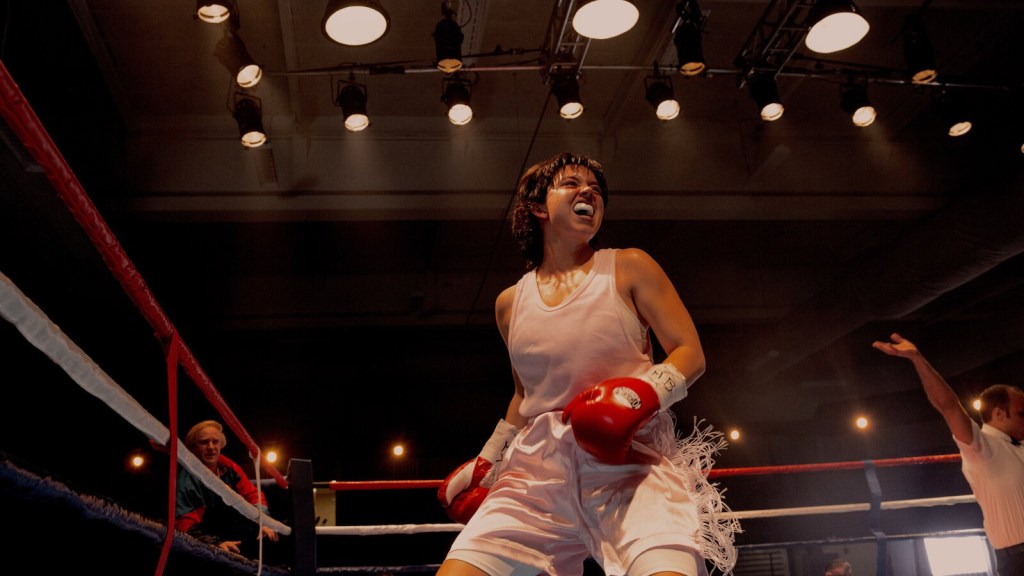
The life and the incredible career of Christy Martin, the most successful female boxer of the 1990s.


I will admit before I saw the film I remeber the UNTOLD series documentary on Christy Martin. So I knew the twist and turns of the story 

so watching it now, more as a docu-drama The film strangely felt like one of those premium cable movies from the 1990s usually on HBO was a star surrounded by a recognizable cast with questionable wigs.

Sydney Sweeney does the best that she can in the role and shows that she has range but it’s not quite as strong as one would hope. As here she feels like a star, trying to be a character actor instead of a character trying to be a star. She’s good enough to be possible and shows a determination that serves the film.

As most will come to this film to see if she has what it takes and does she have that star power. Which she does, but is still working on craft. As she tries to hide her looks and transform into a character. That isn’t quite successful.

Though that is the problem with the film, everything here feels just good enough to be possible, but there’s nothing special to it. There’s nothing that is quite that memorable or has a quality that sticks with you after the film so that it just comes across as very satisfactory and basic, but nothing special.

Even as director David Michod tries to go with a plain, report to his directing. More matter of fact than stylish. To go with a more natural approach.

Not to belittle the main character’s life in life, so which is very dramatic, but that is how the film should feel not so matter fact, things just happen even as it has the theme of the character, knowing her sexuality and trying to be everything to everybody else, but never quite being true to herself and once she does, she is punished for it mercilessly. So that you can see why she might’ve been afraid in the first place. 

Though you’re giving hints to her sexually your same sex preferences, it always seems more like flirting more than us ever truly seeing a romance, even when it comes to who she finally ends up with we see the blossoming as camaraderie and the development of a friendship, more than anything leading to a romance and her relationship before we’re thrust in the middle of and see the painful break up and ending of rather than the maintenance of or the beginning of

Her mother comes across as just a big villain as her husband, as she leaves more mental and emotional scars rather than physical ones.

Ben foster is noteworthy and registers as a jealous scumbag if a human being, but again surprisingly he is holding back. As the film never truly presents why Christy’s  character would fall for him or even be devoted for him as he’s pretty much a bad guy from when we first were introduced to him.

The main problem with this film is that there’s too much talent associated with this film for it to be this impassive overall. It feels like the filmmakers are frayed as there are too many true life characters still alive to really say anything definitive about any of them.

Grade: C+

THE LUCKIEST MAN IN AMERICA (2024)

Directed By: Samir Oliveros 

Written By: Samir Oliveros and Maggie Briggs 

Story By: Amanda Freedman 

Cinematography: Pablo Lozano 

Editor: Sebastian Hernandez 

Cast: Paul Walter Hauser, Walton Goggins, Maise Williams, David Straitharn, Shamier Anderson, Johnny Knoxville, Brian Geraghty, Shaunte Renne Wilson, Damien Young, Patti Harrison, Haley Bennett, Genesis Rodriguez 

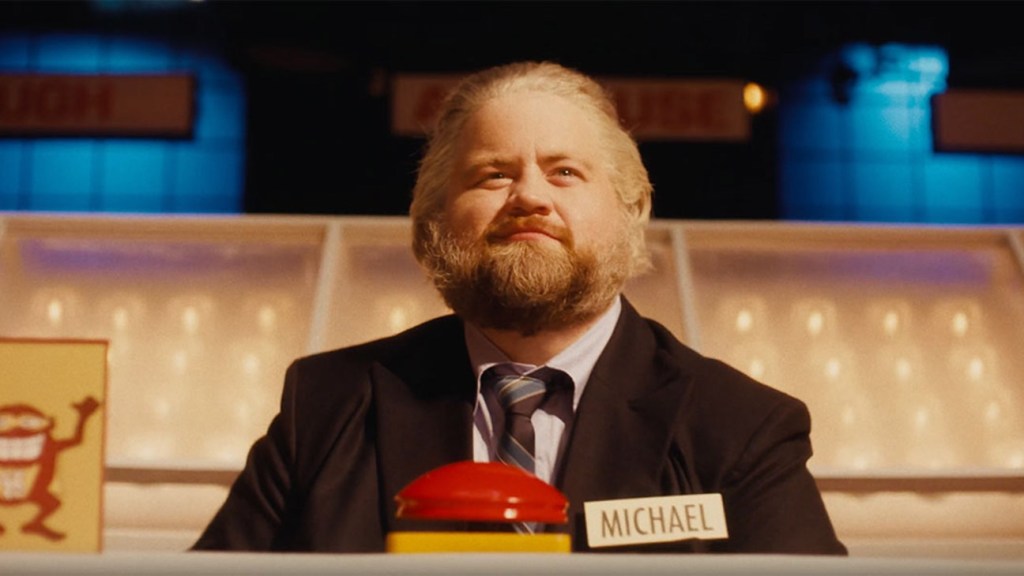
May 1984. An unemployed ice cream truck driver steps onto the game show Press Your Luck harboring a secret: the key to endless money. But his winning streak is threatened when the bewildered executives uncover his real motivations.


I know most of the story just from articles and watching the short documentary on the case and the character on Netflix. BIG BUCKS: THE PRESS YOUR LUCK SCANDAL. The only truth it seems to keep is the memorizing of the patterns of the game board to win.

The story that this film tells has been in development hell since 2000. When bill murray was attached to the film, before aging out and dropping interest in it. 

The film of course didn’t have enough time nor the budget to tell the whole story in multiple events and days that this actually happened during hand on different shows so instead condenses it mostly all into one day and the film taking place in one studio do more to probably the production constraints

The film has a very impressive cast of actors all likable they hear they seem thrown into this production that means well, but ultimately comes across like a TV movie on the subject only with foul language allowed in.

As the film keeps going along at first you wonder is this supposed to be more of a character piece or what is his motivation truly and what it all about while the film shows the slippery politics have not only show business but also production as we see the reaction to his winning from the exact to the behind the scenes production staff to the other contestants, the host and partly the audience, and finally where the film really gets emotional at its heart is in the final 10 to 15 minutes of the film

It’s great to see Paul Walter Hauser have another leading man role as a kind of lovable misfit out there who has tons of get rich, quick schemes, and this one finally might actually pay off that he believes will help solve everything, but only seems to help rip it apart even more.

You only wish the actors had a better film or were given a better script overall or at least a slightly bigger production to be in

It’s a satisfying story, especially if you’ve never heard it before and will induce you to do your own research more into the story but other than that, it’s one of these stories that you feel should’ve been done better or been at least illustrated a little bit better. it’s none of the actor‘s fault who all rise in the occasion. It’s just that by the end it doesn’t quite feel as satisfying as it should, though by the end, it does hit an emotional level. That is unexpected.

Grade: C+ 

THE FIRE INSIDE (2024)

Directed By: Rachel Morrison 

Written By: Barry Jenkins 

Cinematography: Tommy Daguanno and Rina Yang 

Editor: Harry Yoon

Cast: Ryan Destiny, Brian Tyree Henry, De’Andre Aziza, Idrissa Sanogo Bamba, Adam Clark, Olunike Adeliyi, Chrystian Buddington, Lanette Ware, Sarah Allen 

Claressa Shields becomes the first American woman to win a gold medal only to learn that not all dreams are created equal.

————————————————————————

That is truly what the film is about the passion that fires inside that won’t let you quit for any reason even when you try to walk away, there’s something that keeps bringing you back to it. That is what the film and the filmmakers tried to instill in this inspirational true story.

Though the second half of this film is more eventful. As well as the achievements of the person in real life this film is based upon. The film set up a strong foundation. Which we see as the discovery and maintenance of her drive and passion.

The film offers a look at her personal life, and those that she seeks out to support and those who truly support her. As the route, no character is one dimensional they managed to turn themselves around or show their true colors. 

In that way, the film already plays against the traditional where all of a sudden one character stays the same throughout except for one scene or one final act where all of a sudden they change it kind of an apology or change for the worse. 

The film is very inspiring, even showing what happens after initial success, and all the hoopla dies down. It shows how to maintain and find meaning afterwards, as well as the power of community when it comes to support in all different ways. 

The film is a familiar story of sports discipline and training and saving someone from a bleak future by fighting against all odds .

The film doesn’t have as much fighting scenes as he would expect as it is more dealing with the day-to-day drama of her life, and her family unit parental child bonding with her coach and his family, and the jealousy provides in her family who seemed dysfunctional they were always changing and evolving Usually for the better though there are some trials and tribulations for the worse.

No truthfully, it’s that drama that keeps the film afloat and keeps the audience interested as this is a film of hope and what can be achieved with hard work, finesse, and belief in oneself 

Grade: B-